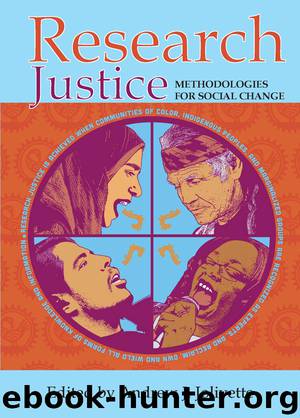
Research Justice: Methodologies for social change by Andrew J. Jolivétte
Author:Andrew J. Jolivétte
Language: eng
Format: azw3
Publisher: Policy Press
Published: 2015-07-22T04:00:00+00:00
Case I: Southern Hyogo prefecture earthquake, 1995
An M-7.3 earthquake hit the urban center of Kobe and its surrounding areas in the early morning of Tuesday, January 17, 1995, claiming more than 6,000 lives and displacing more than 300,000 residents. It was the most devastating disaster in the country at that time since the Second World War. As a port city and an industrial hub, Kobe has historically been one of the major destinations in Japan for migrants from Korea, China, and India (Miyauchi, 2004). More recently, the city has received migrants and refugees from the Philippines, Vietnam, Brazil, and Peru, among other countries, and consistently ranks among the cities with the highest proportion of residents with non-Japanese nationalities (Sasaki, 1995; Miyauchi, 2004). Many of these migrants had founded their communities through labor, religious, and ethnic networks in the face of harsh discrimination and racism, establishing ‘ethnic enclaves' in certain parts of the city (Miyauchi, 2004). The houses and buildings in which they lived tended to be old, overcrowded, and vulnerable to earthquakes and fires, as in the case of Nagata Ward, which houses one of the largest concentrations of Zainichi Koreans, or Korean postcolonial exiles and their descendants residing in Japan.4 While non-Japanese residents accounted for 2.9% of the city's total population in 1995, they made up 4.0% of the victims in Kobe (Sasaki, 1995). My paternal grandmother was one of the thousands of Zainichi Koreans whose houses were demolished by the disaster; she survived, fortunately, because she was sleeping on the second floor when the ground floor was crushed. My Japanese maternal grandmother lived in the same Nagata Ward, but on a hillside rather than the lowlands where many Koreans concentrated. Thus, her neighborhood was less severely affected.
Despite its large population of non-Japanese residents, Kobe was not equipped to aid them in a disaster situation. In the aftermath of the earthquake, those who did not have sufficient Japanese skills suffered from lack of information in languages they could understand; without language support, they could not obtain crucial information on the extent of the devastation, evacuation procedure, relief aid, governmental compensation, housing and relocation, and so on (Takatori Community Center, 2005). Undocumented and unauthorized migrants underwent extreme hardship because they could not receive aid and support for fear of deportation; regardless of immigration status, many migrants who had not joined the national health insurance system were forced to cover the entire medical costs incurred by the disaster (Miyauchi, 2004). Some of the Vietnamese survivors also faced racist discrimination at the evacuation spaces due to stereotypes, the language barrier, and cultural misunderstandings (Takatori Community Center, 2005). For instance, Japanese evacuees would feel threatened by the group of Vietnamese evacuees or irritated by their young children; in the stressful post-disaster situation, this would easily lead to conflicts that would only be exacerbated by the lack of language resources. Meanwhile, the Vietnamese also had conflicts among themselves due to political and ideological differences between northern and southern Vietnam. Furthermore, many of the Vietnamese
Download
This site does not store any files on its server. We only index and link to content provided by other sites. Please contact the content providers to delete copyright contents if any and email us, we'll remove relevant links or contents immediately.
| Anthropology | Archaeology |
| Philosophy | Politics & Government |
| Social Sciences | Sociology |
| Women's Studies |
Cecilia; Or, Memoirs of an Heiress — Volume 1 by Fanny Burney(32538)
Cecilia; Or, Memoirs of an Heiress — Volume 2 by Fanny Burney(31936)
Cecilia; Or, Memoirs of an Heiress — Volume 3 by Fanny Burney(31925)
The Great Music City by Andrea Baker(31912)
We're Going to Need More Wine by Gabrielle Union(19032)
All the Missing Girls by Megan Miranda(15927)
Pimp by Iceberg Slim(14477)
Bombshells: Glamour Girls of a Lifetime by Sullivan Steve(14046)
For the Love of Europe by Rick Steves(13873)
Talking to Strangers by Malcolm Gladwell(13341)
Norse Mythology by Gaiman Neil(13333)
Fifty Shades Freed by E L James(13229)
Mindhunter: Inside the FBI's Elite Serial Crime Unit by John E. Douglas & Mark Olshaker(9313)
Crazy Rich Asians by Kevin Kwan(9271)
The Lost Art of Listening by Michael P. Nichols(7487)
Enlightenment Now: The Case for Reason, Science, Humanism, and Progress by Steven Pinker(7303)
The Four Agreements by Don Miguel Ruiz(6741)
Bad Blood by John Carreyrou(6610)
Weapons of Math Destruction by Cathy O'Neil(6261)
